
Quick Summary
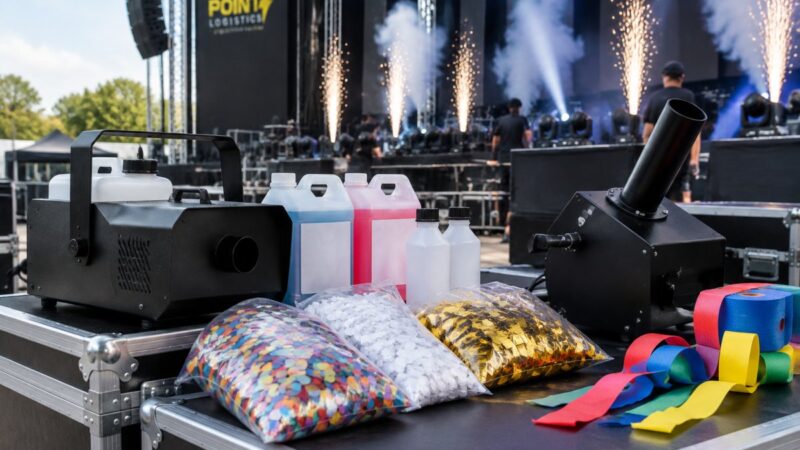
Stage effect equipment procurement is the process of defining, specifying, sourcing and buying fog machines, confetti cannons, streamers, stage fluids and powder products for a production. It covers venue approval, safety compliance, buy-versus-rent costs, vendor qualification and placing the order.
- Write the effect as a description of what the audience should see and hear before naming any product.
- Confirm venue rules and the enforced NFPA edition before finalizing any purchase.
- Compare buying against renting using total cost of ownership, not the purchase price alone.
- Request itemized quotes that separate equipment, consumables, delivery and service fees.
- Test the full control chain, from console to fixture, before the show rather than during it.
Table of Contents
- What Stage Effect Equipment Procurement Covers and Who Needs It
- Defining Needs and Assessing Stakeholder Requirements
- Stage Effects Equipment Checklist: Specifications and Interoperability
- Stage Effects Safety Requirements for Venues and Production
- Buy or Rent Stage Effects Equipment: Budgeting and Total Cost of Ownership
- Stage Effects Procurement Process: Vendor Qualification, Bids and Approval
- Placing Your First Stage Effect Equipment Order With Flashpoint Logistics
- Frequently Asked Questions
What Stage Effect Equipment Procurement Covers and Who Needs It
Last Updated: November 12, 2026
Stage effect equipment procurement is the process of identifying, specifying, sourcing and buying the fog machines, confetti cannons, streamers, stage fluids and powder products that a production needs. This kind of purchase is more involved than most purchase orders.
Several groups need this guide. Owners of small and mid-sized pyrotechnics companies need supply chain support and a clear view of compliance. Operations managers at live event production firms need dependable rentals and specialized equipment on a fixed schedule.
A common mistake is treating stage effects as a simple accessory purchase.
Defining Needs and Assessing Stakeholder Requirements
Good procurement starts with a written description of the effect, not a product name. Describe what the audience should see and hear, where it happens, how long it runs and how many times it repeats in a performance.
Stakeholders usually have different priorities. The designer cares about visual impact, the production manager cares about crew time and rigging, the venue cares about fire and safety rules, and the finance lead cares about total cost. List each stakeholder’s requirements separately before you compare any equipment.
Ask a few practical questions for each effect:
- How large is the area it must cover, and is the space indoor or outdoor?
- How many performances or event days will it run, and how often will it fire?
- Who operates it, and what training do they have?
- What does the venue permit, and who must approve it in writing?
The answers determine whether you need a purchase, a rental, or a service from a provider who handles operation as well as supply.
Stage Effects Equipment Checklist: Specifications and Interoperability
Before requesting quotes, check each candidate item against a specification checklist that is specific to the effect category.
CO2 and compressed-gas effects. Confirm the gas supply, regulator and hose specification, the nozzle type, and the duty cycle.
Rigging and mounting. Record the weight, the mounting pattern, the safety-bond point and the working-load limit.
Power. List voltage, amperage, inrush current and connector type for every unit.
Consumables and spares. Note the fluid or powder SKU, shelf life, storage temperature and whether the vendor stocks replacements locally.
Interoperability deserves special attention. An effect that works on its own can fail once it shares a control network with lighting and video.
Stage Effects Safety Requirements for Venues and Production
Safety requirements are the most important filter in stage effects procurement, and they vary by venue and jurisdiction.
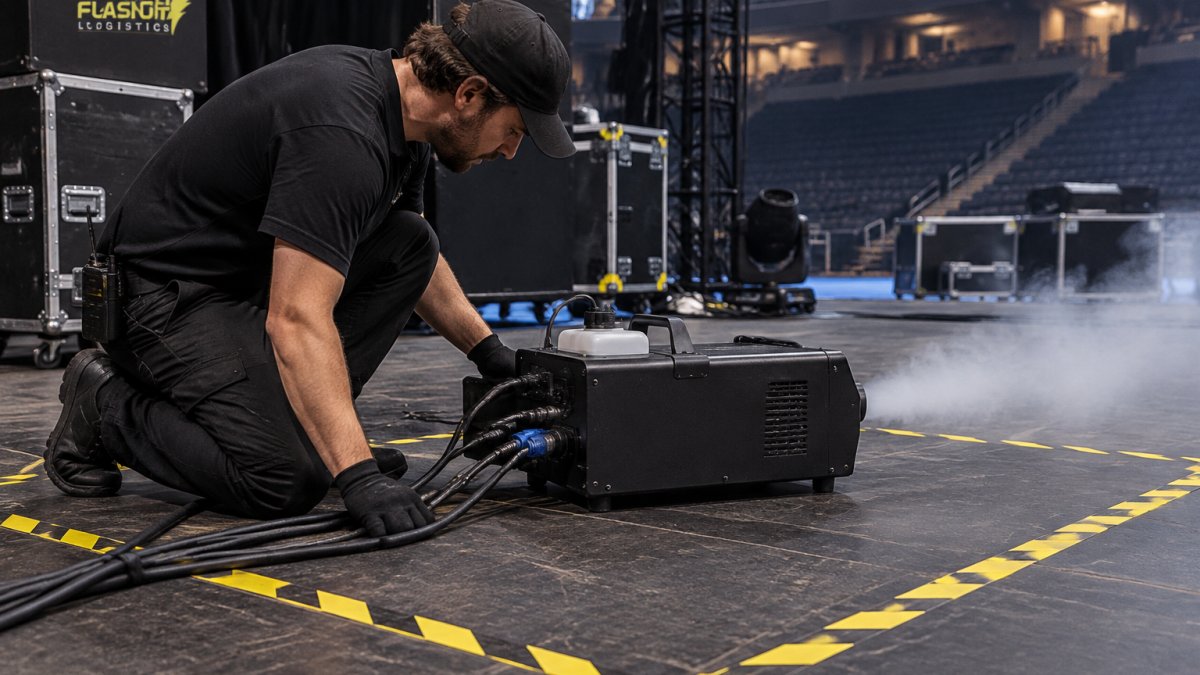
Venues often require advance notice, a site walk-through, written approval from the fire marshal, and a licensed operator for certain effects. Many venues also specify clearance distances, fire-retardant materials and ventilation requirements for fog and haze.
Production teams should also plan for storage, transport and handling of powder and pyrotechnic products. Keep records of who handles each item, where it is stored between events, and what documentation the supplier provided. Retaining these records simplifies inspections and protects your team if questions come up later.
Buy or Rent Stage Effects Equipment: Budgeting and Total Cost of Ownership
The purchase price is only part of the cost.
Build a simple comparison before deciding. Estimate the annual number of events, the cost of consumables per event, and the cost of one rental per event. Then compare the annual total for each path.
The right structure depends heavily on production scale:
- Touring shows. Renting or leasing usually wins. The rig changes venues weekly, transport and insurance are already in the tour budget, and a rental house absorbs repair and replacement risk. Buying only makes sense for a signature effect the tour cannot source locally.
- Permanent venues. Buying usually wins for effects used every week, such as house haze or a fixed confetti position. Budget for consumables, cleaning and an annual service visit, and keep a spare unit for the highest-risk effect.
- Schools and community theaters. Renting or hiring a specialist operator is often the safest path, because the venue may lack the electrical capacity, rigging points and trained staff a purchased unit assumes.
- One-off events. Renting is almost always cheaper once delivery, setup labor and post-event cleaning are counted. A purchased machine that runs once a year still needs storage, insurance and a service check before each use.
Cost components to put in the budget, beyond the equipment itself:
- Delivery and return freight, including crating for fragile units
- Rigging hardware, safety bonds and truss point engineering
- Consumables at the actual per-show rate, not the catalog estimate
- Cleaning and residue removal, especially for powder and oil-based haze
- Storage with temperature control for fluids and gas cylinders
- Insurance riders for owned equipment and for rented equipment in your custody
- Operator training and refresher training when staff turns over
- Repair and spare-parts reserve, typically a percentage of replacement value per year
- Replacement cycle, since heaters, pumps and solenoids wear out on a known duty cycle
Pricing for stage effects depends on quantity, dates, delivery distance and the specific products selected. Current prices are available on the Flashpoint Logistics website, and a direct quote is the most reliable way to build your budget.
Watch out: comparing a rental day rate to a purchase price without adding consumables, cleaning, storage and the labor to operate the owned unit routinely understates the owned cost by a wide margin.
Stage Effects Procurement Process: Vendor Qualification, Bids and Approval
A structured procurement process protects the budget and the schedule. A typical sequence runs from needs definition, to a shortlist, to a request for quote, to evaluation, to approval and purchase order.
When qualifying a vendor, look for:
- Clear product documentation and manufacturer specifications
- Written safety guidance and a willingness to discuss compliance
- Transparent delivery timelines and a plan for peak event season
- Consulting support for handling, storage and regulatory questions
- References or case studies from comparable productions
Ask each shortlisted vendor for an itemized quote that separates equipment, consumables, delivery and any service fees. A quote that bundles everything into one figure makes it hard to compare offers fairly.
Stick to a written evaluation method for every bid so that the choice is defensible later.
The article lists the steps a team should follow when qualifying vendors and approving a purchase.
| Step | What to do | Note |
|---|---|---|
| Needs definition | Finalize the specification and budget | Sets the baseline for comparison |
| Shortlist | Identify candidate vendors | Use the qualification criteria |
| Request for quote | Ask for itemized quotes | Separate equipment, consumables, delivery and service |
| Evaluation | Score each vendor on the same criteria | Record reasons for any exceptions |
| Approval | Route through purchase authority | File with quote and specifications |
| Purchase order | Place the order and keep records | Keep the full production file |
Placing Your First Stage Effect Equipment Order With Flashpoint Logistics
Once the specification, safety review, budget and vendor choice are settled, placing the order is straightforward. Start by browsing the current range on the Shop Flashpoint Logistics products page to match items to the checklist you built earlier.
Before you submit an order, confirm quantities against the event schedule, check delivery dates against your load-in window, and make sure the required documentation is in hand for the venue. If a question about compliance or the right equipment for a venue comes up, the Flashpoint Logistics explosives consulting services can help you review the safety requirements before you commit. You can also review the Flashpoint Logistics certifications to verify the company’s credentials as part of your vendor file.
Keep the completed specification, approval record and purchase order together. That file will save time on your next production, and it gives your team a repeatable process for every future stage effect purchase.
Best for: Production teams and event organizers planning stage effects for a defined show or season.
Button: Shop Stage Effect Equipment
CARD_TITLE: Need stage effect equipment you can plan around?
CARD_TEXT: Flashpoint Logistics supplies stage effect machines, fluids, confetti, streamers and powder products with same-day product shipping.
Frequently Asked Questions
What equipment is used to create stage effects?
Stage effects are typically produced with fog and haze machines, confetti and streamer cannons, pyrotechnic-safe effect units, lighting-linked effect controllers, and powder or effect consumables. The exact mix depends on the show’s size and venue rules. Before ordering, list every effect the production needs, then confirm each machine’s output, power draw, control options and compatibility with the venue’s fire and electrical requirements. Buying a single system that covers most cues often simplifies setup and training for the crew.
How do you choose the right stage effect machine for an event?
Start with the venue size, ceiling height, audience distance and the number of effect cues. A small club needs far less output than an arena, and fog density should match the lighting design. Check control options such as DMX or wireless triggering, runtime on the included fluid, warm-up time and maintenance access. Ask for specifications in writing and confirm that the machine suits the stage effect products you plan to run, since fluid and consumables must match the equipment.
What should be included in a stage effects equipment procurement plan?
A solid plan lists the production’s effect requirements, quantities, delivery dates, venue constraints, safety obligations and approved budget. It should also name the decision makers, the vendor evaluation criteria and the documents needed for approval, such as specification sheets and insurance certificates. Include a line for consumables, spares and staff training, since these often cost more over a season than the initial purchase. Record the procurement decision and rationale so future audits and budget reviews can trace it.
What safety factors should you consider when buying stage effects equipment?
Review electrical ratings, grounding, heat output, fluid safety data sheets and the clearance distances the manufacturer specifies. Confirm that the equipment meets the codes your venue and local authority enforce, and ask the vendor for documentation you can retain. Plan for fire marshal review where pyrotechnic or flame-adjacent effects are involved, and make sure operators are trained in emergency shutdown procedures. Safety should be checked at delivery and recorded during commissioning, not assumed from the product brochure.
How do you estimate the cost of stage effects equipment?
Estimate costs across the full lifecycle rather than the purchase price alone. Include the equipment, freight, insurance, power and installation, recurring fluid and consumable costs, maintenance, repairs, spare parts and crew training. Multiply expected uses per year by consumable cost per use to reveal running expenses. Pricing depends on quantity, dates and delivery, so request a current quote from Flashpoint Logistics through its website for accurate figures.
What supplies and consumables are needed for stage effects machines?
Most stage effects systems need compatible fluid, replacement filters or nozzles, cleaning supplies and power cables or adapters. Confetti and streamer systems require the correct shot material, loading tools and replacement cartridges, while powder effects need approved powder products and sealed storage. Keep a consumables schedule tied to show dates so supplies arrive before each run. Verify that every consumable is listed by the machine manufacturer to avoid performance or warranty problems.
Should event producers buy or rent stage effects equipment?
Renting suits one-off events, touring shows with unfamiliar venues, or productions testing a new effect before committing capital. Buying makes sense when equipment will run frequently across a season, because the cost per use drops and the crew learns one system thoroughly. Compare the total rental cost for your expected schedule against the purchase price plus maintenance and storage. Factor in delivery timing and whether the vendor offers local availability, since delays can cost more than the rental fee itself.
How do you compare stage effect equipment suppliers?
Compare suppliers on specification accuracy, documentation quality, safety support, delivery reliability, consulting availability and after-sale service. Ask each vendor for references from similar productions and for written answers about consumable availability during peak season. Request bids that itemize equipment, consumables, shipping and any rush fees so the totals are comparable. A supplier that offers compliance guidance and can handle the full range of your effect types may reduce the number of vendors you must manage.
