
Table of Contents
- Understanding Pyrotechnic Supply Logistics for Live Events
- Event Pyrotechnics Permits and Approvals
- Pyrotechnic Transport and Storage Requirements
- Live Event Pyrotechnics Safety Checklist
- Sourcing Pyrotechnic Equipment and Supplies
- Coordinating Delivery Schedules and Event-Day Execution
- Budgeting and Cost Management for Pyrotechnic Operations
- Frequently Asked Questions
Last Updated: October 21, 2026
Understanding Pyrotechnic Supply Logistics for Live Events
Pyrotechnic supply logistics covers sourcing, transporting, storing, and delivering professional fireworks and pyrotechnic equipment to live events, from permit applications through post-event inventory reconciliation.
The real challenge isn’t finding equipment, it’s coordinating regulatory approvals, hazardous material shipping, equipment inspection, crew scheduling, and contingency planning at once.
One missed permit deadline or delivery miscommunication can derail an entire event. Smooth execution comes down to planning and coordination from the start.
Event Pyrotechnics Permits and Approvals
Permits are your first critical step.
Start by contacting your local fire department. They control most permitting decisions for live events in your area. You’ll typically need:
- A detailed show design and script
- Proof of pyrotechnician licensing and experience
- Insurance documentation
- Site plans and safety perimeter maps
- Hazardous materials handling certifications
Most jurisdictions require permits 30 to 60 days before your event, some longer. Submit early, rejections and revisions eat into your buffer.
State rules vary, and some require approvals beyond local permits. Federal oversight applies if your event crosses state lines or involves certain explosive classifications.
Keep copies of every approval, inspection report, and regulator communication, these records prove compliance if questions arise later.
Pyrotechnic Transport and Storage Requirements
Transport and storage are where pyrotechnic logistics most often break down, because the rules are specific and the paperwork is auditable. This section covers the compliance mechanics that determine whether your materials legally arrive and legally sit on site.
Transport: the DOT hazmat framework
In the United States, fireworks and most theatrical pyrotechnic materials move as hazardous materials under Department of Transportation rules in 49 CFR Parts 100-185. The practical implications for an event team:
- Classification and shipping papers. Each product must be described on a shipping paper using its proper shipping name, hazard class, UN/NA identification number, and packing group. Fireworks typically fall under Class 1 (explosives) entries such as UN0333, UN0334, UN0335, or UN0336 depending on the article and division. The shipper is responsible for accurate classification, do not let a supplier hand you a generic “fireworks” line.
- Packaging and authorization. Explosives must be packaged under an approved packaging authorization (often a DOT-E or DOT-SP special permit, or an approved packaging per the hazardous materials table). Ask your supplier for the packaging authorization reference on the shipping paper.
- Placarding and vehicle marking. Vehicles carrying Class 1 materials require the appropriate placards on all four sides, plus the required emergency response information (ERG guide page) accessible in the cab.
- Driver qualifications. The driver needs a commercial driver’s license with a hazmat endorsement (H endorsement), a current DOT medical card, and security threat assessment clearance. Brokers who dispatch “a box truck” without verifying the endorsement create liability for the event.
- Routing and parking. Hazmat routes and tunnel/bridge restrictions apply in many jurisdictions. A common pattern is to pre-plan the route to avoid dense pedestrian zones and to identify a legal parking/staging point near the venue before the truck leaves the supplier.
A shipping paper with the wrong UN number or missing emergency response information can get the load refused at a weigh station or, worse, at the venue gate. Verify the paperwork against the product list before dispatch, not on event day.
Storage: magazines, segregation, and site rules
Storage rules split into two phases, pre-event and on-site.
Pre-event storage. Explosives must be stored in an approved magazine (Type 1-5 depending on quantity and location) or an approved indoor facility meeting NFPA 495 and, where adopted, the International Fire Code. Key controls:
- Quantity limits based on magazine type and distance to inhabited buildings, highways, and property lines (the American Table of Distances).
- No smoking, open flame, or spark-producing tools inside or near the magazine.
- Separate storage of detonators/igniters from bulk explosive materials where required by the authority having jurisdiction (AHJ).
- Log every in/out movement with date, time, quantity, and initials, this is your chain-of-custody record.
On-site storage. At the venue, the AHJ (usually the fire marshal) sets the day-of rules. Expect to:
- Keep materials in locked, labeled containers or a designated day box until load-in.
- Maintain the fire department’s required separation distance from the audience, structures, and parking.
- Post a fire watch and keep extinguishers and a water supply at the storage point.
- Never leave product unattended in a public area, even briefly during setup.
Documentation to carry
Build a transport and storage packet that travels with the load:
- Shipping papers with proper shipping names and UN numbers
- Packaging authorization references
- Driver CDL and hazmat endorsement copies
- Vehicle insurance certificate naming hazardous materials
- Magazine storage log and chain-of-custody sheet
- Site storage plan approved by the AHJ
The transport and storage section is not about buying the right equipment, it is about proving, on paper and at the gate, that the material is classified, packaged, driven, and stored legally. Build the packet once and reuse it for every event.
Live Event Pyrotechnics Safety Checklist
Before any equipment arrives at your venue, establish a comprehensive safety plan.
Your checklist should include:
- Confirm all crew members have current pyrotechnician licenses
- Verify insurance coverage meets or exceeds venue requirements
- Inspect all equipment for damage or defects before transport
- Establish clear communication protocols between crew and event coordinators
- Mark safety perimeters and restrict public access to equipment zones
- Test firing systems and backup ignition methods
A backup for every critical component isn’t optional. If your primary firing system fails mid-show, your backup prevents a dangerous scramble or incomplete display.
Wind, rain, and temperature changes affect equipment performance. Have contingency plans for weather delays or cancellations, and know in advance whether your insurance covers weather-related postponements.
Sourcing Pyrotechnic Equipment and Supplies
Finding the right supplier shapes your entire operation, whether you’re running a small local festival or a large-scale corporate event.
Look for suppliers who offer:
- A full range of stage effect machines and display equipment
- Professional-grade confetti, streamers, and powder products
- Same-day or next-day shipping during peak event season
- Technical expertise to match equipment to your show design
- Compliance documentation for all products
- Responsive customer service when problems arise
A supplier who understands your local regulations can flag permit issues before they become problems.
Flashpoint Logistics works with event professionals across the industry.
Smaller operations often hesitate to ask suppliers for guidance, a mistake. Experienced suppliers know what works and what creates headaches.
Coordinating Delivery Schedules and Event-Day Execution
Event day is a sequence of handoffs where timing, paperwork, or weather can break the plan. Here is a working timeline, contingency triggers, and a post-event reconciliation workflow.
A working event-day timeline
Times are relative to show start (T-minus). Adjust for venue size and AHJ requirements.
- T-7 days: Confirm delivery window in writing with the supplier. Reconfirm the shipping paper, UN numbers, and driver hazmat endorsement. Send the site access plan (gate, dock, parking, escort contact) to the carrier.
- T-24 hours: Weather check and go/no-go call with the pyro lead and event producer. Confirm the AHJ inspection time. Stage backup firing system and spare igniters.
- T-8 to T-6 hours: Truck arrives. Gate check: verify shipping paper against the packing list, count containers, inspect for damage, and sign the chain-of-custody sheet. Move product to the approved on-site storage point.
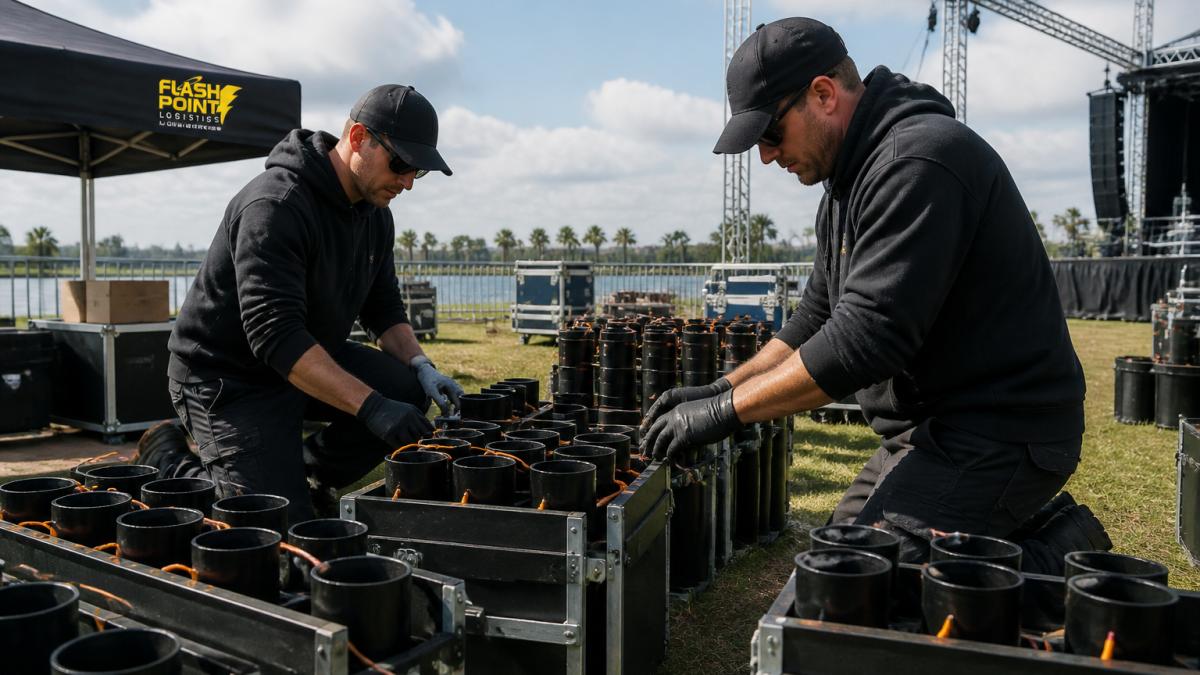
- T-6 to T-4 hours: Crew load-in. Set mortar racks, run field cable, position firing system and backup. AHJ walkthrough and sign-off.
- T-3 hours: Full system test, primary and backup. Test continuity on every cue. Document results.
- T-60 to T-30 minutes: Final safety brief, perimeter check, fire watch in position, medical standby confirmed. Last weather call.
Contingency triggers, not just contingency plans
A plan that says “have a backup” is not a plan. Define triggers in advance so the crew acts instead of debating:
- Delivery delay > 2 hours: Activate the pre-arranged alternate carrier or the supplier’s local stock; notify the AHJ of the revised inspection time.
- Sustained wind above the AHJ limit or the manufacturer’s limit: Halt loading, secure the product, and hold for the next weather window. Do not “wait and see” with product on the racks.
- Primary firing system failure at test: Switch to backup and re-test all cues before continuing. If backup also fails, the show does not go.
- Lightning within the AHJ radius: Evacuate the pyro zone and shelter; resume only after the all-clear from the fire marshal.
- Injury or fire: Stop the show, execute the emergency action plan, and preserve the site for investigation.
Write the triggers on a single card and give a copy to the event producer, the fire watch, and the pyro lead. Shared triggers prevent the most common failure, two people making different calls at the same moment.
Post-event inventory reconciliation and return
This is the step most teams under-document, and it is where unexpected charges and compliance exposure appear.
- Count against the manifest. Reconcile fired, unfired, damaged, and returned items line by line. Note discrepancies immediately, not the next day.
- Photograph everything. Damaged containers, unfired product, and the storage area before load-out.
- Complete the chain-of-custody close-out. Both the pyro lead and the carrier sign the return sheet with counts and condition.
- Handle unused product compliantly. Unfired explosives return to an approved magazine or go back to the supplier under a new shipping paper, they cannot sit in a venue closet or a personal vehicle.
- File incident and inspection records. Keep AHJ inspection reports, test logs, and any incident documentation with the event file for the retention period your insurer and the AHJ require.
- Reconcile the invoice. Match the supplier invoice to the signed return sheet before approving payment; this is where damage and shortage disputes are won or lost.
Event-day execution is a timed sequence of verified handoffs. The teams that run clean shows are the ones with written triggers, a single point of contact, and a reconciliation sheet signed before the truck leaves.
Budgeting and Cost Management for Pyrotechnic Operations
Understanding each cost category helps you build realistic budgets and avoid surprises.
Your primary costs include:
- Equipment rental or purchase
- Pyrotechnician labor and crew fees
- Permits and regulatory compliance
- Insurance and liability coverage
- Transport and delivery
- Storage and secure handling
Pricing depends on quantity, event dates, and delivery requirements. Peak summer season costs more than off-season dates, and rush delivery adds premiums.
Build contingency reserves into your budget. Equipment damage, permit delays, or weather-related changes cost money.
Document spending on permits, labor, equipment, and supplies.
Professional pyrotechnic supply logistics demands attention to detail, regulatory knowledge, and reliable partnerships.
Flashpoint Logistics has helped event professionals navigate these challenges. Our team provides same-day shipping, extensive industry expertise, and competitive pricing on stage effect machines, confetti, streamers, and powder products.
Frequently Asked Questions
What permits and approvals are required for pyrotechnics at a live event?
Most jurisdictions require permits from local fire marshals, police departments, and sometimes the ATF if you’re transporting hazardous materials across state lines. You’ll need proof of liability insurance, a detailed show design, and documentation of your pyrotechnician’s licensing. Contact your venue and local authorities early, approval timelines vary from two weeks to several months. Flashpoint Logistics can guide you through compliance requirements specific to your event location.
How should pyrotechnic supplies be transported and stored before an event?
Transport pyrotechnic equipment and supplies in DOT-compliant vehicles with proper placarding for hazardous materials. Store in a cool, dry, locked facility away from ignition sources, with adequate ventilation. Keep inventory logs and maintain separation between different product types. Never store in residential areas or shared buildings. Temporary on-site storage must meet fire code distance requirements from structures and spectators. Professional logistics partners handle documentation and compliance to keep your operation safe and legal.
What should be included in a live event pyrotechnics safety checklist?
Your checklist must cover equipment inspection for damage or defects, backup firing systems for redundancy, clear communication protocols between crew members, weather assessment and contingency plans, spectator barrier placement, and emergency contact information. Include verification that all ignition control systems function properly, mortars and racks are secure, and licensed pyrotechnicians are on-site. Document all pre-show tests and post-event inventory. A comprehensive safety checklist prevents accidents and demonstrates due diligence to insurance carriers and regulators.
How do I coordinate pyrotechnic deliveries with venue access and show schedules?
Start by confirming venue load-in times, parking restrictions, and equipment storage locations with event management. Provide your supplier with a detailed delivery schedule at least two weeks before the event, specifying arrival windows and setup requirements. Coordinate with your licensed pyrotechnician on crew arrival times to allow for equipment inspection and system testing before the show. Build in buffer time for contingencies. Communication between your supplier, venue coordinator, and show designer prevents delays and ensures all equipment arrives ready for setup and execution.