
Table of Contents
- 1. Plan Your Confetti Effect Within the Event Timeline
- 2. Secure Venue Approval and Verify Confetti Compliance Requirements
- 3. Create a Stage Confetti Safety Checklist Before Load-In
- 4. Determine How Much Confetti to Order for Your Event
- 5. Design Your Confetti Effect Cue Sheet and Show Sequencing
- 6. Coordinate Load-In, Storage, and Equipment Setup
- 7. Execute Your Event Confetti Cleanup Plan
- Frequently Asked Questions
Last Updated: October 18, 2026
1. Plan Your Confetti Effect Within the Event Timeline
Stage confetti logistics requires careful planning from the moment you book your venue. Your confetti effect doesn’t exist in isolation, it’s one piece of a larger event schedule. The best practices for stage confetti logistics start with understanding where your effect fits into the run of show and how much time you need for setup, execution, and cleanup.
Begin by mapping your event timeline backward from your confetti moment. Ask yourself: When does the effect happen? How long does it take to load equipment? When do crew members need to arrive? How much time exists between your confetti cue and the next stage element?
Most event producers miss this step and rush the logistics later. A confetti effect that takes 30 seconds to execute might require 2-3 hours of advance setup. If you don’t build that into your event schedule, your timing falls apart.
Work with your production crew and stage manager early. They’ll tell you realistic load-in windows and equipment positioning needs. Include breaks between shows in your timeline, confetti debris creates slip hazards, and cleanup crews need time to work safely.
Document your confetti timing in your official event schedule, not just your production notes. Share it with venue management, security, and all crew members. Everyone needs to know when confetti happens and what happens before and after.
2. Secure Venue Approval and Verify Confetti Compliance Requirements
Venue approval is non-negotiable. Many venues have strict rules about stage effects, and confetti rules vary widely. Some venues prohibit confetti entirely. Others allow it only in specific areas or require special cleanup procedures.
Contact your venue in writing at least 30 days before your event. Ask these specific questions:
- Does the venue allow confetti on stage?
- Are there restrictions on confetti type or volume?
- What cleanup requirements apply?
- Does the venue require additional liability insurance for confetti effects?
- Are there fire safety or environmental health and safety rules that apply?
Your venue may require you to use biodegradable confetti, limit quantities, or designate specific cleanup zones. Some venues demand proof of compliance before approving your event. Document all venue rules in writing.
Check your local fire safety regulations and environmental rules. Some jurisdictions restrict certain confetti materials. As documented in NFPA fire safety guidelines, stage effects must comply with local fire codes and safety standards.
Create a venue approval checklist specific to confetti:
- Venue permits written confetti use ✓
- Confetti type approved by venue ✓
- Cleanup plan accepted by venue ✓
- Insurance requirements confirmed ✓
- Fire safety compliance verified ✓
- Environmental restrictions identified ✓
Proceeding without written venue approval risks event shutdown, liability claims, or venue bans. Get approval in writing before you order equipment or schedule your crew.
3. Create a Stage Confetti Safety Checklist Before Load-In
A stage confetti safety checklist protects your crew, your audience, and your event. Safety requirements aren’t optional, they’re essential to smooth event execution.
Your stage confetti safety checklist should include:
Pre-Event Safety Checks:
- Inspect all confetti cannons for damage or malfunction
- Verify equipment meets manufacturer specifications
- Check that all crew members have safety training
- Confirm slip hazard signage is ready for placement
- Review emergency procedures with your production crew
Load-In Safety Procedures:
- Designate a safe stage access area for equipment delivery
- Ensure stage is clear of obstacles before equipment arrives
- Use proper lifting techniques, confetti equipment can be heavy
- Place equipment away from audience sight lines until cue time
- Secure all equipment to prevent accidental discharge
Execution Safety Requirements:
- Brief all crew on the exact confetti cue and timing
- Ensure audience members are at safe distance from stage
- Position crew to manage debris and slip hazards
- Have cleanup crew standing by during effect
- Monitor for unexpected equipment behavior
Post-Effect Cleanup:
- Begin cleanup immediately after confetti settles
- Use wet cleanup methods to prevent confetti becoming airborne again
- Check for confetti in lighting rigs, sound equipment, and stage machinery
- Verify all debris is removed from stage before next performance
Your safety checklist becomes your operational standard.
4. Determine How Much Confetti to Order for Your Event
Ordering the right quantity of confetti prevents waste and budget overruns. Order too little, and your effect looks thin. Order too much, and you’re paying for product you won’t use.
Calculate confetti quantity based on three factors: stage size, confetti cannon capacity, and visual effect intensity.
Stage Size:
A small stage (under 20 feet wide) needs less confetti than a large stage (40+ feet). Confetti disperses differently on small versus large stages. Larger stages require more volume to create the same visual impact.
Confetti Cannon Capacity:
Most standard confetti cannons hold 5-10 pounds of confetti per charge. A single cannon discharge creates a visible effect. Multiple simultaneous discharges create a dramatic effect but use more product.
Visual Intensity:
Do you want a light confetti shower or a heavy burst? A light effect might use 10-15 pounds total. A heavy effect might use 50+ pounds. Your creative vision determines quantity.
Start with a baseline: 1-2 pounds per cannon per discharge. If you’re firing three cannons simultaneously, that’s 3-6 pounds per effect. If you repeat the effect three times during your event, multiply by three.
Example: Three cannons, three discharges, 2 pounds per cannon per discharge = 18 pounds minimum. Add 20% buffer for testing and contingencies. Order 22 pounds.
Order confetti from a supplier who understands event production. Flashpoint Logistics offers same-day shipping on confetti quantities, which means you can order closer to your event date without risk of delay.
5. Design Your Confetti Effect Cue Sheet and Show Sequencing
Your confetti effect cue sheet is the operational document that tells your stage manager and crew exactly when to execute the effect. It’s part of your larger run of show, but it deserves its own detailed attention.
Your confetti effect cue sheet should include:
Cue Number and Timing:
- Cue 47: Confetti burst at 2:15 into song
- Exact time code or music cue point
- Who triggers the cue (stage manager, pyro engineer, or automation)
Equipment Assignment:
- Cannons 1, 2, 3 fire simultaneously
- Cannon 4 fires 2 seconds after initial burst
- Each cannon fires once per cue
Safety and Staging Notes:
- Audience positioned 15 feet from stage edge
- Cleanup crew stands by stage left
- Slip hazard signs placed before effect
Post-Effect Sequencing:
- Cleanup begins immediately
- 90 seconds cleanup time before next stage element
- Lighting shift happens during cleanup
Contingency Plan:
- If Cannon 1 malfunctions, fire Cannons 2 and 3 only
- If cleanup takes longer than 90 seconds, delay next element by 30 seconds
- Backup confetti supply available stage right
Your show sequencing integrates confetti timing with music, lighting, and other stage effects. A confetti moment that lands on a music crescendo creates emotional impact. Confetti that interrupts dialogue or a quiet moment feels disconnected.
Work with your music director and lighting designer. Coordinate timing so all stage effects support each other. Flashpoint Logistics can help you think through equipment integration and timing logistics as part of our consulting services.
6. Coordinate Load-In, Storage, and Equipment Setup
Load-in logistics determine whether your equipment arrives safely and on time. Poor load-in planning creates delays, equipment damage, and crew frustration.
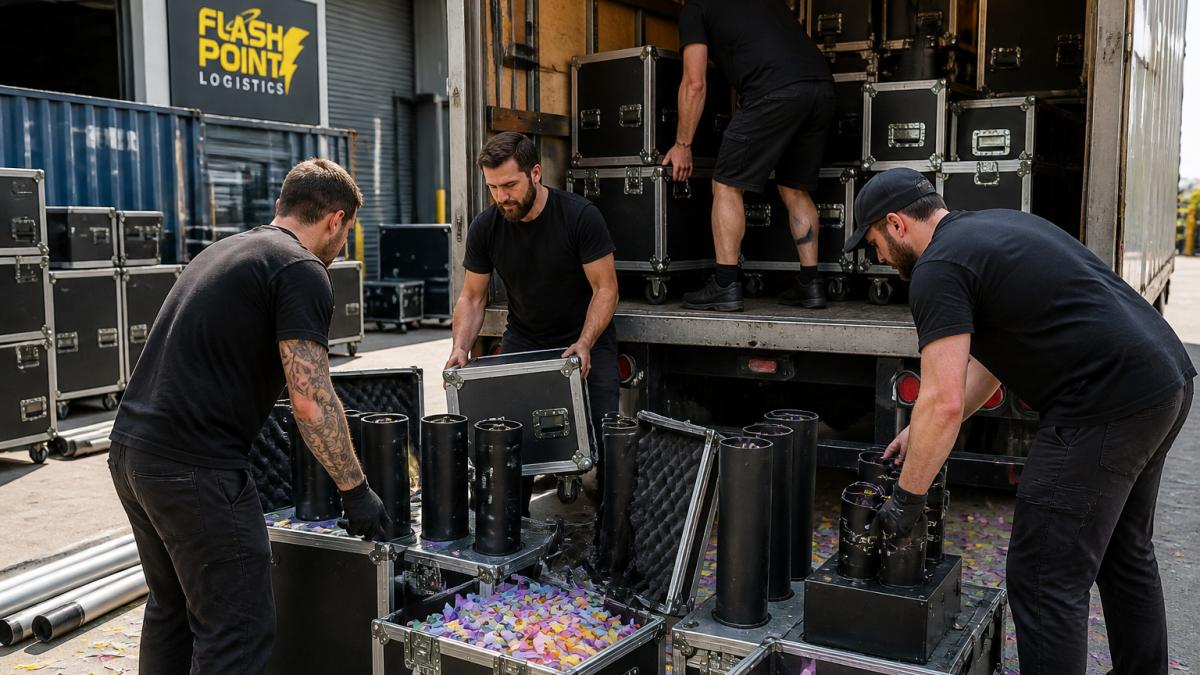
Establish Your Load-In Timeline:
Create a detailed load-in schedule that specifies arrival times for each piece of equipment. Work backward from your event start time.
- 4:00 PM: Truck arrives, equipment unloaded
- 4:15 PM: Confetti cannons positioned on stage
- 4:45 PM: Equipment tested and safety checked
- 5:15 PM: Crew briefing and final checks
- 6:30 PM: Standby for event start
Designate Storage Areas:
Confetti equipment needs secure storage during load-in. Identify a locked storage area near the stage. Keep confetti and equipment protected from weather, foot traffic, and unauthorized access.
Store confetti in a cool, dry location. Moisture damages confetti and reduces effect quality. Keep confetti away from heat sources and direct sunlight.
Manage Equipment Transport:
If you’re transporting equipment yourself, use a truck with climate control if possible. Secure equipment so it doesn’t shift during transport. Use padding and straps to prevent damage.
Coordinate Crew Assignments:
Assign specific crew members to specific tasks. One person manages equipment unloading. Another positions cannons on stage. A third person conducts safety checks. Clear assignments prevent confusion and reduce setup time.
According to OSHA guidelines on workplace safety, proper crew coordination and clear task assignments reduce on-site accidents and improve operational efficiency.
Conduct Equipment Testing:
Test all confetti cannons before your event begins. Fire each cannon with a test charge to verify function. Check that discharge angles are correct and equipment is secure.
7. Execute Your Event Confetti Cleanup Plan
Cleanup is where many event producers fail. Confetti creates slip hazards and debris that must be removed quickly. A thorough cleanup plan prevents accidents and protects your venue relationship.
Immediate Post-Effect Cleanup:
Cleanup begins the moment confetti settles. Position your cleanup crew on stage with brooms, dustpans, and wet cleanup supplies.
Use mops and water to collect confetti debris. Confetti that lands in stage machinery, lighting rigs, or sound equipment needs careful removal. Assign a crew member to check these areas specifically.
Debris Removal and Containment:
Collect confetti debris in large trash containers. Don’t scatter debris around the venue, contain it and remove it promptly. Some venues require you to haul debris off-site immediately. Check your venue agreement.
If your event is outdoors, confetti can blow into landscaping, parking areas, or neighboring properties. Use tarps and containment barriers to manage debris. Clean these areas thoroughly before you leave.
Timeline for Cleanup:
Plan for 30-60 minutes of active cleanup after a standard confetti effect. Larger effects or multiple discharges require more time.
Crew Assignments:
- Lead cleanup person: coordinates overall effort
- Stage sweep crew: removes debris from stage surface
- Equipment crew: cleans machinery and lighting rigs
- Debris removal crew: hauls confetti to containers
Cleanup is not optional, it’s part of your confetti logistics. A venue that receives thorough cleanup will approve your event again. A venue that finds confetti debris days later will ban you.
Your cleanup plan reflects your professionalism. Venues remember how you leave their space. The best practices for stage confetti logistics include leaving the venue in better condition than you found it.
Flashpoint Logistics understands event production demands. We provide expert consulting on equipment selection, safety protocols, and operational planning.
Confetti effects create memorable moments, but they require serious operational planning. Contact Flashpoint Logistics today to discuss your stage effect needs and discover how our equipment and consulting services can support your next event.
Frequently Asked Questions
What should be included in a stage confetti safety checklist?
A comprehensive stage confetti safety checklist covers equipment inspection, venue clearance, crew training, and risk assessment. Verify all confetti cannons are certified and functioning. Confirm the venue permits confetti use and has no fire code restrictions. Assign a dedicated safety officer. Check for slip hazards and debris removal zones. Ensure your crew knows emergency procedures and has proper personal protective equipment. Test all timing cues and communication systems before the event. Document any modifications to your show design that affect safety.
How much confetti to order for an event depends on what factors?
Confetti quantity depends on venue size, cannon capacity, number of effects, and desired visual impact. Account for test runs during setup and contingency stock. Consider your confetti type: tissue confetti is lighter and spreads further than metallic confetti. Consult with your supplier on density recommendations for your specific venue and effect design. Order early during peak event season to ensure availability.
How do you prepare a confetti effect cue sheet for stage management?
A confetti effect cue sheet documents each launch timing, duration, cannon assignment, and audio/visual synchronization. Number each cue sequentially and note the exact song timestamp or stage manager call. Include cannon type, confetti load weight, and expected effect duration. List responsible crew members for each cue and backup procedures if equipment fails. Add weather contingencies for outdoor events. Share the finalized cue sheet with your stage manager, lighting operator, and audio technician at least 48 hours before the event. Conduct a full run-of-show rehearsal to verify timing and crew communication.
What’s the best way to plan an event confetti cleanup?
Plan cleanup by assigning dedicated crew, identifying cleanup zones, and budgeting sufficient time. Use industrial vacuums and push brooms to remove confetti from floors, seats, and stage. Separate cleanup into phases: immediate post-effect removal, detailed cleanup, and final inspection. Communicate cleanup expectations to your venue contact before the event. Arrange waste disposal early; confetti volume can exceed 50 pounds after a full show. Include cleanup costs and labor in your overall event budget.